City of Orlando Paver Permit: Engineering Process (2026)
City of Orlando Paver Permit: The Engineering Process
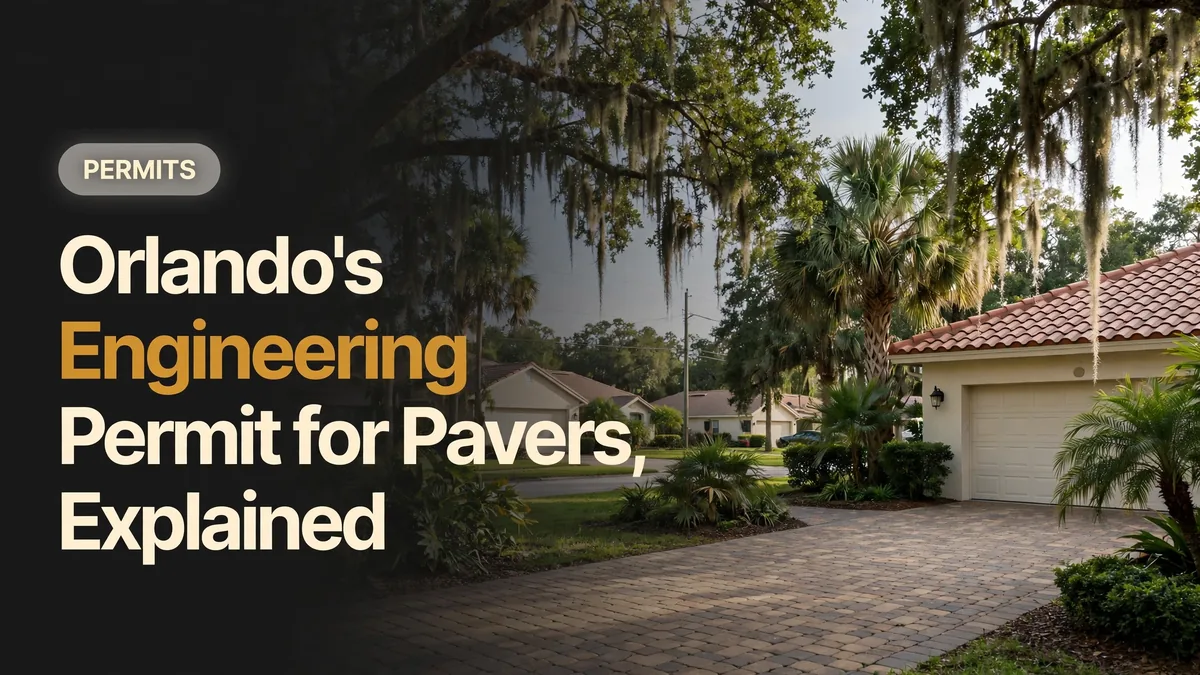
If your home is inside Orlando city limits, your paver project needs an Engineering Permit, not an ordinary building permit. The city treats installing or removing pavers, asphalt, or concrete, and expanding a driveway, as engineering work. Filing the wrong application type is the single most common reason these projects stall. That is the key thing to know; below is the full process, the impervious-surface limit, and the right-of-way rules that catch driveway jobs.
This guide is for homes inside the City of Orlando only. Many Orlando, FL addresses are actually unincorporated Orange County, which uses a completely different process covered in our Orange County paver permit guide. Confirm your jurisdiction first, because everything here depends on it.
Why It Is an Engineering Permit, Not a Building Permit
This is where most Orlando city projects go wrong before they start. The City of Orlando does not process pavers as a standard building permit. Its own guidance is explicit: if you are removing or installing pavers, asphalt, or concrete, or expanding your driveway, and it is a civil site project not tied to a building construction project, an Engineering Permit is required.
The city’s Engineering Permit forms cover exactly this kind of work: driveways, pavers, gradings, and similar horizontal projects. Applying as if it were a building permit, or under the wrong category, is a common cause of delay, because the application ends up with the wrong reviewers. Getting the permit type right on the first try is half the battle.
The Two Permits a Driveway Can Trigger
A paver driveway inside the city often needs more than one approval, because part of the work is on your property and part may be in the public right-of-way.
On your property
The Engineering Permit covers construction, reconstruction, repair, alteration, or grading of site improvements on private property. That is the paver surface itself.
In the right-of-way
The strip in the street, under the sidewalk, or in the grassy area next to the street is public right-of-way, not your land. Work there, including a driveway approach, needs a separate Right-of-Way Permit.
The Right-of-Way Paver Agreement, and Its Catch
Here is a detail unique to putting decorative pavers in the city right-of-way that homeowners rarely see coming. When you place pavers in the public right-of-way, the city can require a Right-of-Way Driveway Pavers Agreement. This is not an easement and not any kind of ownership. The city is explicit that it is a license, terminable at will.
In plain terms: the pavers in the right-of-way are there on the city’s permission, which the city can withdraw. If the agreement is terminated, or if a utility or the city needs access, you are responsible for removing the pavers and restoring the right-of-way at your own cost. If you do not, the city can remove them, invoice you, and place a lien on your property for unpaid costs. The agreement gets recorded in the public records and runs with the property.
The ISR Limit: How Much You Can Pave
Orlando controls how much of your lot can be covered with hard surface through the Impervious Surface Ratio (ISR). Municipal Code 61.302(b) sets the ISR limits by zoning district, and the city confirms compliance with an ISR worksheet.
Pavers, concrete, and other hard surfaces count toward your lot’s impervious total, so a large driveway, a wide addition, or a new parking pad can push you over the limit for your zone. This is the city’s equivalent of the county’s 40 percent open space rule, and it is the constraint that most often shrinks or blocks a driveway expansion. If the ISR is tight, a permeable paver system can help, because permeable surfaces manage stormwater rather than shedding it. Our 40% open space rule guide explains the county equivalent.
Driveway Rules: Width and Materials
The city also regulates the driveway itself. Municipal Code 61.302 sets standards for driveway width, semi-circular driveways, and prohibited materials. If you are widening a driveway, adding a circular drive, or choosing a non-standard material, those rules govern what is allowed. An installer who works inside the city knows the current limits, which is one reason the driveway and driveway extension jobs benefit from someone familiar with Orlando’s code.
Trees: an Easy-to-Miss Trigger
If installing your pavers means removing a tree, you may have triggered a separate requirement. Orlando’s tree removal ordinance can require either a tree removal permit or a report from a TRAQ-certified arborist for a residential property before the tree comes out. If your driveway, patio, or walkway plan involves clearing a tree, factor this in early, because it is a separate approval from the engineering permit and can add time.
City vs County: a Quick Comparison
Same goal, two different systems, and your address decides which applies.
City of Orlando
Pavers go through an Engineering Permit, the impervious limit is the ISR under Municipal Code 61.302(b), and driveway width and materials are set by 61.302.
Unincorporated Orange County
Pavers go through a Zoning permit costing about $76, the impervious limit is the 40 percent open space rule under code 24-29(a), and review takes four business days.
Frequently asked questions
Related Guides
 Do You Need a Permit for Pavers in Orlando?
 Orange County Paver Permit: Process & Fees (2026)Orange County’s 40% Open Space Rule, ExplainedDriveway Apron & Right-of-Way Permits in OrlandoHOA Approval for Pavers in Orlando (FL Statute 720)Paver Cost in Orlando 2026 (Real Price Ranges)Do You Need a Permit for Pavers in Orlando?Orange County Paver Permit: Process & Fees (2026)Orange County’s 40% Open Space Rule, ExplainedDriveway Apron & Right-of-Way Permits in OrlandoHOA Approval for Pavers in Orlando (FL Statute 720)Paver Cost in Orlando 2026 (Real Price Ranges)
Get a Free, Itemized Paver Estimate in Orlando
Inside the City of Orlando, pavers need an Engineering Permit, governed by the ISR and Municipal Code 61.302. The wrong application type is the classic stall. Tell us about your project and we will match you with a vetted local contractor who works inside the city. Call (689) 686-8021 or request a quote online.