HOA Approval for Pavers in Orlando (FL Statute 720 Guide)
HOA Approval for Pavers in Orlando (FL Statute 720)
If your home is in a homeowners association, you almost certainly need written architectural approval before installing pavers, and it is separate from your government permit. Florida Statute Chapter 720 lets your HOA’s architectural review committee approve the material, color, and design of exterior work first. In many Orlando communities that approval takes longer than the county permit does. Here is how the process works, what your HOA can and cannot do, and a 2026 legal change that helps you.
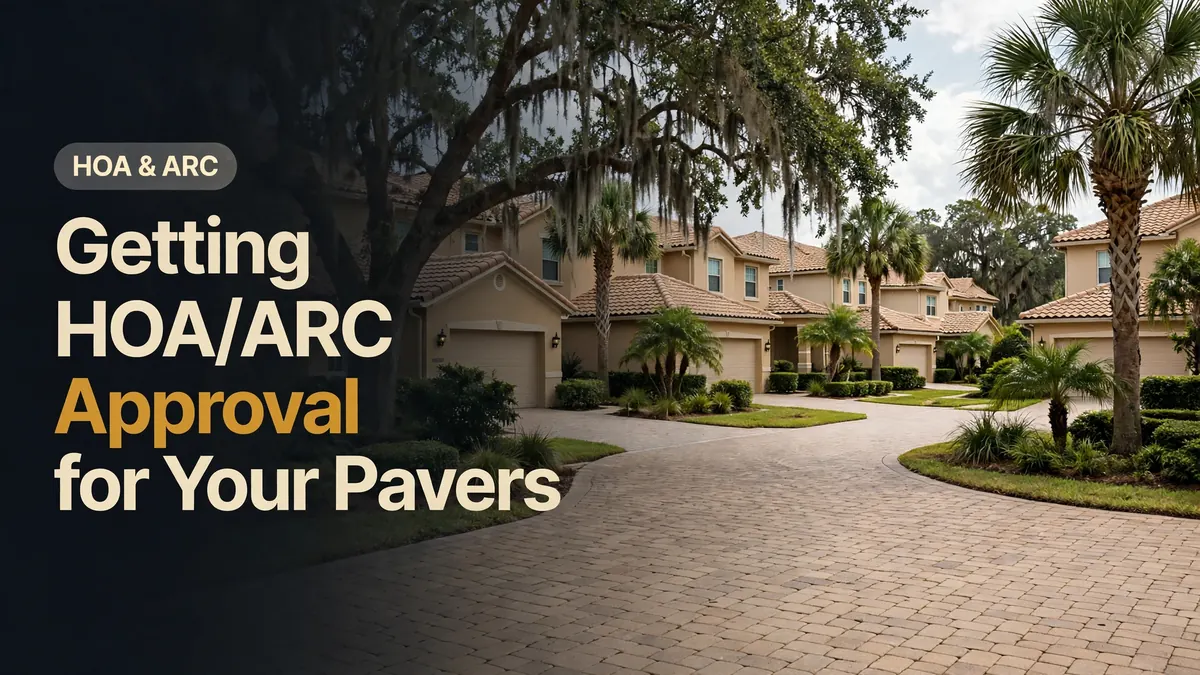
Why HOA Approval Is Separate From Your Permit
This is the first thing to understand: clearing the government permit does not clear your HOA, and vice versa. They are two independent approvals. Florida Statute Chapter 720, the Homeowners’ Association Act, governs planned communities with deed restrictions and a mandatory HOA. Where the community’s declaration provides for it, the HOA has authority over the external appearance of lot improvements, including a paver driveway, walkway, or pool deck. So a paver project in an HOA community typically needs both the Orange County or City of Orlando permit and the HOA’s architectural sign-off.
In many Orlando-area master-planned communities, Lake Nona, Baldwin Park, the gated Windermere neighborhoods, the architectural review is the longer of the two, so it pays to start it early.
What the ARC Can and Cannot Control
The architectural review committee has real authority, but it is not unlimited, and Statute 720.3035 draws the line.
What the ARC can do
Review and approve the location, size, type, material, color, and appearance of your pavers, as long as it applies standards already written into the governing documents.
What the ARC cannot do
Invent new criteria on the spot, require a specific vendor or product unless it is in the declaration, or deny a compliant application without facing a civil action.
If you are denied, you are entitled to know exactly which rule your application failed.
Written Denials Are Required
A 2024 change tightened what an HOA must do when it says no, and it works in your favor. If the association denies an architectural request, it must provide written notice specifying exactly which rule or covenant it relied on and exactly which part of your request was non-conforming. A vague denied is not enough. This gives you a clear path to fix the specific problem and resubmit, rather than guessing at what the committee wanted.
The 2026 Change That Helps You: Permit Not Required First
Here is a genuinely useful update most homeowners and even some contractors do not know about yet. Effective July 1, 2026, House Bill 803 amended Statute 720.3035 to address a common headache: many exterior changes that need ARC approval also need a building permit, and homeowners were getting stuck in a chicken-and-egg loop.
The statute now provides that an HOA or its ARC may not require you to have a government building permit issued as a prerequisite for the ARC’s review. In other words, your failure to obtain the permit before submitting to the ARC is not a valid basis to deny your application. Practically, this means you can run the HOA approval and the government permit in a sensible order without the HOA blocking you for not having the permit in hand first.
The 30-Day Auto-Approval Myth
You will read all over the internet that a Florida HOA has 30 days to respond to an architectural application or it is automatically approved. Be careful with this, because it is not quite right.
Florida Statute 720.3035 does not set a universal 30-day deadline. There is no statutory clock that applies to every HOA. What actually matters is the deadline written into your community’s declaration. Many older Florida HOA declarations do include an automatic-approval provision, commonly 30, 45, or 60 days from a complete submission, and Florida courts treat missing that internal deadline as constructive approval. But the number, and whether it exists at all, comes from your governing documents, not from a blanket state rule. Always check your own declaration for the real deadline rather than assuming 30 days.
How the Process Usually Works
- Read your governing documents first to find the ARC’s application requirements, any approved-material or color list, and the response deadline in your declaration.
- Prepare the application with what the guidelines ask for, commonly a site plan, the paver material and color, and sometimes samples.
- Submit to the ARC as a complete package. A complete submission is what starts any deadline in your declaration.
- Wait for the written decision. Approval lets you proceed; a denial must tell you the specific rule you failed so you can correct and resubmit.
- Then handle your government permit and schedule the work. Thanks to the 2026 change, the HOA cannot make you get the permit before its review.
Which Orlando Communities This Affects Most
The master-planned and gated communities have the most active architectural review: Lake Nona and Laureate Park with their strict New Urbanist palettes, the gated Windermere communities like Isleworth and Keene’s Pointe, Baldwin Park with its community association, and the gated enclaves in Dr. Phillips and Lake Mary. In these communities, plan the ARC submission as early as the permit, because it often takes longer.
Frequently asked questions
Related Guides
 Do You Need a Permit for Pavers in Orlando?
 Orange County Paver Permit: Process & Fees (2026)City of Orlando Paver Permit: The Engineering ProcessOrange County’s 40% Open Space Rule, ExplainedDriveway Apron & Right-of-Way Permits in OrlandoPaver Cost in Orlando 2026 (Real Price Ranges)Do You Need a Permit for Pavers in Orlando?Orange County Paver Permit: Process & Fees (2026)City of Orlando Paver Permit: The Engineering ProcessOrange County’s 40% Open Space Rule, ExplainedDriveway Apron & Right-of-Way Permits in OrlandoPaver Cost in Orlando 2026 (Real Price Ranges)
Get a Free, Itemized Paver Estimate in Orlando
In an HOA community, a paver project needs architectural approval under Florida Statute Chapter 720, separate from and often slower than your government permit. Want an installer who knows your community’s palette and handles both together? Tell us about your project and we will match you with a vetted local contractor. Call (689) 686-8021 or request a quote online.